
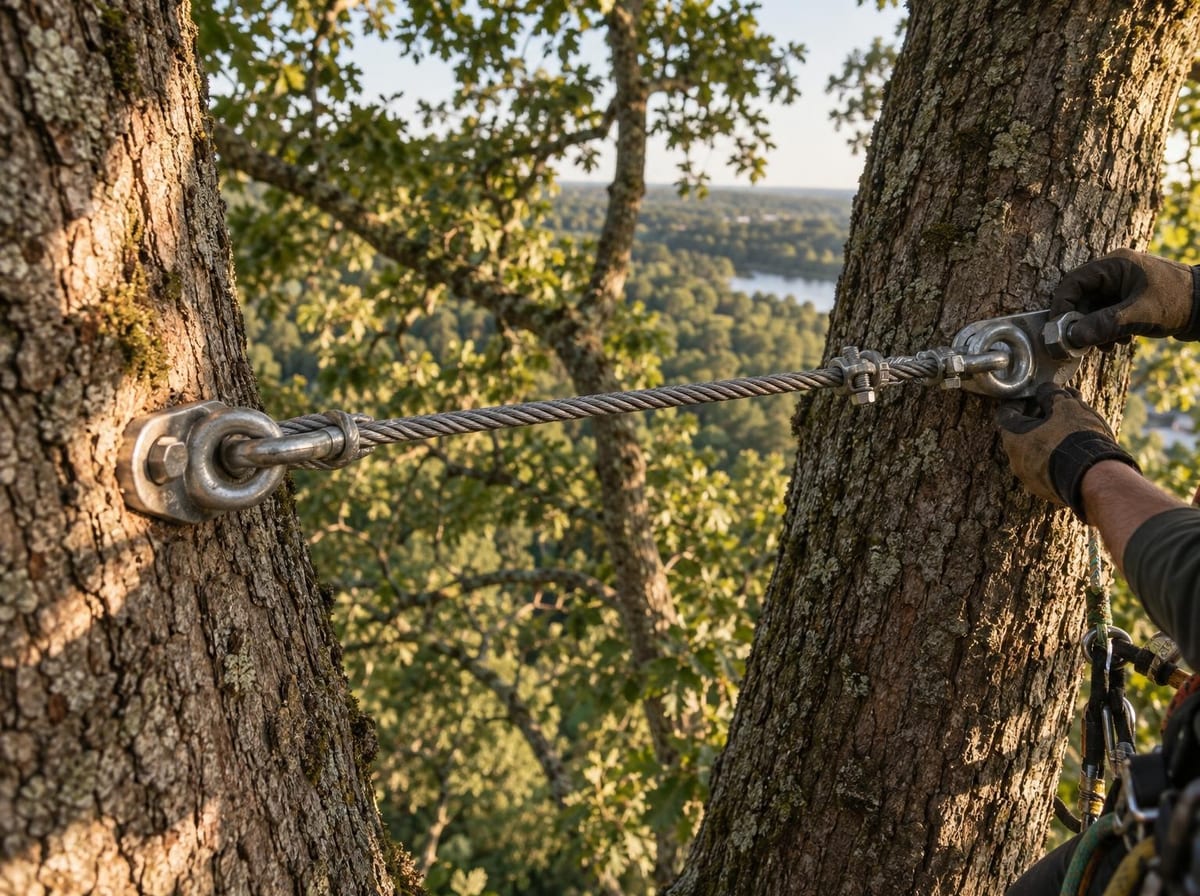
What this covers
Support systems are for a specific situation: a co-dominant union with included bark, a heavy horizontal limb over something that matters, or a split that has been caught early. A cable installed high in the canopy limits how far the two leaders can move apart in wind. A through-brace does more direct work on a union that has already begun to fail.
It is worth being clear about what hardware does and does not do. It reduces the chance of failure at that union. It does not make the tree sound, and it is not a permanent fix left alone. A supported tree carries an inspection commitment, and the hardware itself has a service life. Sometimes the honest answer is that removal is the better decision.
Scope
| Considered for | Co-dominant stems with included bark, heavy horizontal limbs over targets, and early-stage splits |
|---|---|
| Options | Static or dynamic cabling high in the canopy, and through-bracing at a union that has begun to fail |
| Ongoing | Supported trees need periodic inspection. Hardware has a service life and is not fit-and-forget. |
| Honest alternative | Where the structure is too far gone, the assessment will say that removal is the sounder option. |
How a request works
You flag the union
A split, a heavy leader, or a crack you have noticed.
Structure is assessed
Whether the union can be supported, and whether support is the right call at all.
Options are compared
Hardware, reduction, monitoring, or removal, with the trade-offs of each explained.